Now that I am back on the blogosphere, I am trying to catch up with blogs I visit regularly. Here are some pics. There will be more.
Pierre Tristam: What to make of this picture ?
Speaking Truth to Power from Boston: More blatant censorship in the US about Palestine and the ME.
Angry Arab: Unfriendly Persuasion, Lebanese who oppose the Sanyura government will not be allowed entry into the US.
Stef: Welcome to NonConspiro world.
Wolfie: Kill your credit before it kills you.
UrShalim: Privatising synthetic life
Homeyra: Once Upon A Time
29.6.07


28.6.07
Bashar to Ban Ki Moon: We are in the eye of the storm and you need to stay in contact with us
Revealed by Le Monde, a strange conversation took place last April between Syrian president Bashar El Assad (BEA) and UN secretary general Ban Ki Moon. It gives a fresh and new perspective on BEA as a head of state and politician but it also gives a clearer picture of the weakness of the new UN secretary general Ban Ki Moon, not only toward his US masters but also toward any head of state and official he meets. It is clear from the conversation that Ban Ki Moon is considered as a US puppet and everything that is said to him by officials is meant to be conveyed to his masters. Lets turn now to the conversation's minutes partially published today by Le Monde and translated here.
The meeting, which lasted more than an hour, was held on April 24th in the presidential palace in Damascus, before the UN took the decision for the Hariri international tribunal.
The situation in Iraq is mentioned but most of the conversation turns around Lebanon. BKM insists on the important role that Syria must play in order to supress Lebanon's internal divisions. He thinks Damascus must encourage the creation of the international tribunal to judge the assassins of Rafiq Hariri, and not the contrary.
The answer of BEA is pungent: "Sectarian and ethnic divisions have been deeply rooted in Lebanese society for more than 300 years. Lebanese society is very fragile and it stabilised only during the Syrian presence between 1976 and 2005 after which Lebanon entered a new period of political instability again."
"The political instability in Lebanon, added BEA, will be aggravated by the special tribunal, especially if it is under chapter seven of the UN convention, which is binding, reinforcing the constraining aspect of the tribunal. That may easily initiate a conflict and can potentially degenerate into a civil war, provoking divisions between sunnis and shias from the Meditterranean to the Caspian seas. This might have grave consequences extending beyond the Lebanese frontier.
"In the eye of the storm"
Syria, said BEA, has always played a constructive role in Lebanon, contrary to the roles played by France and the US. The influence of these two last countries is destructive to Lebanon.
Syrian foreign minister, Walid Mouallem, intervenes at that point to harshly criticize the US ambassador to Lebanon, Jeff Feltman. "Feltman must leave the country. I am ready to offer him a vacation in Hawaï."
BKM, unable to react, continues to recite his well learned lesson, and pleads for a reestablishment of diplomatic relations between Lebanon and Syria. "The present lebanese government is illegal'', replies BEA. ''The Syrian people hate the March 14th movement led by Fouad Siniora. I tried to talk to Siniora, but it is now impossible. However, if a unity government including the opposition is formed, Syria will revise its stance."
BKM continues to recite his lesson and expresses his fears concerning Iran's nuclear ambitions. "As an oriental, you must understand, replies BEA. Iran is a regional power and must be recognised as such. They have the capacity to derail the entire Middle east and beyond. (…) There will be no positive evolution on this question as long as the West does not recognise to Iran the right to be a nuclear power."
The meeeting ends with the usual thanks from BKM to BEA who then says to him: "We are in the eye of the storm. You will need to stay in contact with us."
I am not sure BKM understood the metaphor.
You can hate BEA, you can call him names, you can despise him, but you cannot deny that he is right in what he says. Arrogant yes, but right. Speaking about facts might also look arrogant for an international community which is increasingly neglecting facts, building foreign policies only on the fantasies of the neocon new world order.
The source article in French
P.S and Update: An anonymous reader protested (in an impolite way, go my Néthique's Icon at the top of the blog page if you want to understand what impoliteness) that there might be some translations problems because to plead for ''the reestablishment of diplomatic relations between Syria and Lebanon'' is to ignore that there was never official representation in the first place between Syria and Lebanon.
I am sorry to tell this reader that I had to rely on the article of Le Monde, which, in turn, relied on the minutes of the meeting. The article states: ''M. Ban enchaîne, plaidant pour le rétablissement des relations diplomatiques entre le Liban et la Syrie.'' I doubt Le Monde's journalist mistranslated from the minutes, which might have been in English. However, I believe BKM, or those who wrote the script for him, are totally ignorant of the historic of the situation, which might explain the absence of historic perspective to the words he used in the meeting. As for myself I have to stick to my source, which is le Monde's article.
The meeting, which lasted more than an hour, was held on April 24th in the presidential palace in Damascus, before the UN took the decision for the Hariri international tribunal.
The situation in Iraq is mentioned but most of the conversation turns around Lebanon. BKM insists on the important role that Syria must play in order to supress Lebanon's internal divisions. He thinks Damascus must encourage the creation of the international tribunal to judge the assassins of Rafiq Hariri, and not the contrary.
The answer of BEA is pungent: "Sectarian and ethnic divisions have been deeply rooted in Lebanese society for more than 300 years. Lebanese society is very fragile and it stabilised only during the Syrian presence between 1976 and 2005 after which Lebanon entered a new period of political instability again."
"The political instability in Lebanon, added BEA, will be aggravated by the special tribunal, especially if it is under chapter seven of the UN convention, which is binding, reinforcing the constraining aspect of the tribunal. That may easily initiate a conflict and can potentially degenerate into a civil war, provoking divisions between sunnis and shias from the Meditterranean to the Caspian seas. This might have grave consequences extending beyond the Lebanese frontier.
"In the eye of the storm"
Syria, said BEA, has always played a constructive role in Lebanon, contrary to the roles played by France and the US. The influence of these two last countries is destructive to Lebanon.
Syrian foreign minister, Walid Mouallem, intervenes at that point to harshly criticize the US ambassador to Lebanon, Jeff Feltman. "Feltman must leave the country. I am ready to offer him a vacation in Hawaï."
BKM, unable to react, continues to recite his well learned lesson, and pleads for a reestablishment of diplomatic relations between Lebanon and Syria. "The present lebanese government is illegal'', replies BEA. ''The Syrian people hate the March 14th movement led by Fouad Siniora. I tried to talk to Siniora, but it is now impossible. However, if a unity government including the opposition is formed, Syria will revise its stance."
BKM continues to recite his lesson and expresses his fears concerning Iran's nuclear ambitions. "As an oriental, you must understand, replies BEA. Iran is a regional power and must be recognised as such. They have the capacity to derail the entire Middle east and beyond. (…) There will be no positive evolution on this question as long as the West does not recognise to Iran the right to be a nuclear power."
The meeeting ends with the usual thanks from BKM to BEA who then says to him: "We are in the eye of the storm. You will need to stay in contact with us."
I am not sure BKM understood the metaphor.
You can hate BEA, you can call him names, you can despise him, but you cannot deny that he is right in what he says. Arrogant yes, but right. Speaking about facts might also look arrogant for an international community which is increasingly neglecting facts, building foreign policies only on the fantasies of the neocon new world order.
The source article in French
P.S and Update: An anonymous reader protested (in an impolite way, go my Néthique's Icon at the top of the blog page if you want to understand what impoliteness) that there might be some translations problems because to plead for ''the reestablishment of diplomatic relations between Syria and Lebanon'' is to ignore that there was never official representation in the first place between Syria and Lebanon.
I am sorry to tell this reader that I had to rely on the article of Le Monde, which, in turn, relied on the minutes of the meeting. The article states: ''M. Ban enchaîne, plaidant pour le rétablissement des relations diplomatiques entre le Liban et la Syrie.'' I doubt Le Monde's journalist mistranslated from the minutes, which might have been in English. However, I believe BKM, or those who wrote the script for him, are totally ignorant of the historic of the situation, which might explain the absence of historic perspective to the words he used in the meeting. As for myself I have to stick to my source, which is le Monde's article.
27.6.07
The Agean: Craddle of Civilisations
I was vacationing recently with my family in Greece, Turkey, and their islands around the Agean. What follow are some pictures from this tour.


The Nisanyan Inn at Sirince, Turkey. Its gardens, pool, and the troubles of its owner, the very original and passionnate Turkish intellectual, journalist and author, Sevan Nisanyan and his wife, with the local authorities.


The Nisanyan Inn at Sirince, Turkey. Its gardens, pool, and the troubles of its owner, the very original and passionnate Turkish intellectual, journalist and author, Sevan Nisanyan and his wife, with the local authorities.


Sirince, 10kms from Ephesus, Turkey. originally it was a Greek village. Its inhabitants today are Turks from Thessaloniki who came to the village after its original Greek population were displaced by the ethnic unrests provoked by the fall of the Ottoman empire in the 1920s and the rise of Turkish nationalism.

Priene, Turkey. This is the only antique city that kept its pure Ionian style architecture. This is also where Alexander the great lived when besieging the Persians in neighboring Miletus.


The five fingered mountain at the site of Herakleia, Turkey. You can see the Bafa golu, Lake Bafa, previously the Agean, which retreated from this part of Turkey.


Knidos, Turkey. An ancient city known for its first nude Aphrodite, an Aphrodite lost but reconstructed from drawings. Knidos today is abandoned. It has a small fishing port mainly providing the only restaurant catering to small sailing boats.


The island of Symi, Greece, has many small coves with clear waters where only the goats can watch you swim. There was absolute silence when we arrived in this cove. We can only hear the clarion of the goatee in the far. Then the goatee appeared in company of one or two other goats, inspecting visiotrs on the beach from a distance, to retreat under a shade after the inspection was complete.


Once a week, on monday, a hydrofoil leaves Rhodes, Greece, for Bodrum, Turkey. The journey takes usually two hours, except when there are high winds, which is often the case in the Agean. Our journey from Rhodes to Bodrum lasted three hours and a half. From Bodrum we went on sailing the Agean's small islands between Turkey and Greece on a Catamaran.


A typical view when driving on the roads of the Peloponnese region, Greece. There are more breathtaking views from the mountain roads but we could not get them easily, there were no spots to stop on the mountain road to take pictures of the sea. In addition to the fact that Greeks drive like crazy. The main Péloponnèse highway, which is marked as a highway on the road map, is in fact composed of no n separate two ways road with emergency lanes serving as additional lanes for pushing relatively slower vehicles. Sometimes, the drivers would even sneak between two vehicles in between lanes, with flashing lights. It was hell for more than an hour.


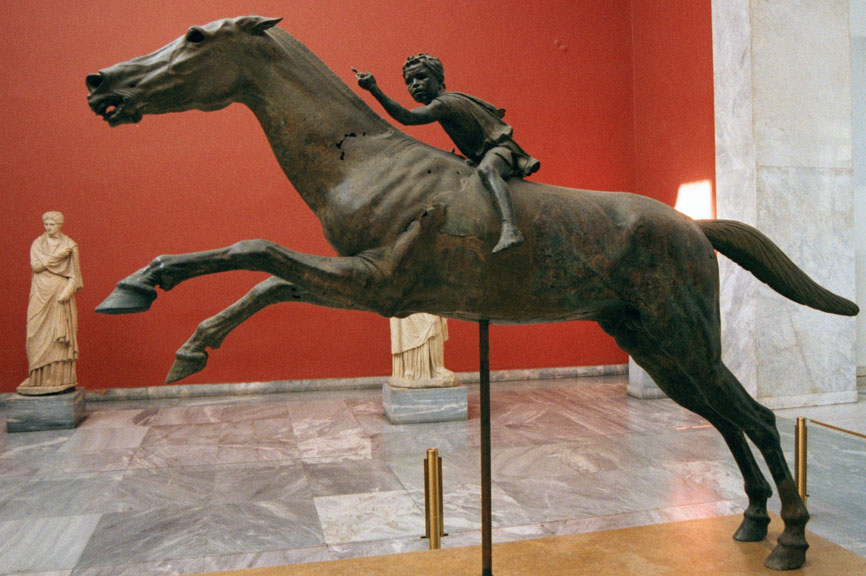
Bronze sculpture of a boy mounting a horse, archeological museum, Athens.
The work is a fascinating example of the human passion which artists of the peak period of the Hellenistic era succeeded in infusing into their most inspired works. It was found in pieces, in the area of a shipwreck off the cape Artemision, in north Euboea. Dated to circa 140 BCE.


20.6.07
What remains of Palestinian resistance should be preserved by new means
I am in a small village in Turkey near Ephesus. Tired of traveling the roads and the sea for more than two weeks, we are relaxing. In the library of the small hotel a nostalgic and beautiful Greek music is playing. Everything is nostalgic here including the setting of the village which is really like my native village in Lebanon, the food, and even the small community, Turkish from Thessaloniki who came here after the original Greek community of the village was displaced in the 1920s.
I opened my news links this morning. The situation in Palestine really depressed me. What became of Fatah and the Palestinian resistance is sad and what will come out from the Hamas takeover will be even more dramatic. Israel will declare Gaza al Qaida territory; Palestinians who will resist will be eliminated in the name of the 'war on terror' and the rest will have to collaborate with the occupier.
I don't mind the elimination of Fatah because they have become irrelevant to the struggle of the Palestinian people since the Oslo process. But I have been dreaming for an outcome for the Palestinians in these difficult times and I think there is only one logical solution left that can counter the implacable logic of the 'war on terror' which is killing resistance movements and especially the Palestinian ones. This solution is to renounce violence and to resist by other means. Non violence does not mean the end of resistance if adequate actions are taken. One of them for Hamas, now that they are rid of collaborationnist Fatah elements and spies for Israel, will be to declare it renounces violence. On the other hand Hamas should declare they will never recognize Israel as it is now eating Palestinian territories from everywhere and making the two state solution practically impossible. Hamas should do the contrary of it has been doing until now; fight by legitimate means the recognition of the state of Israel in its present borders and renounce completely violence. The region has had enough violence. Hamas has the power now over a small Palestinian territory and they should show the world what Palestinian resistance is about; it should be about community and nation building and civil and legal resistance. I am quite convinced that it is the only logical solution to save what remains of Palestinian resistance...
UPDATE, June 24th: Hamas war chief reveals his plan for Gaza in an interview with the Observer.
Alastair Crooke: isolating Hamas was our (Europeans) second biggest mistake in the ME, the Iraq war was the number one mistake.
The last Fatah fighters in Gaza dream of fleeing to Israel
I opened my news links this morning. The situation in Palestine really depressed me. What became of Fatah and the Palestinian resistance is sad and what will come out from the Hamas takeover will be even more dramatic. Israel will declare Gaza al Qaida territory; Palestinians who will resist will be eliminated in the name of the 'war on terror' and the rest will have to collaborate with the occupier.
I don't mind the elimination of Fatah because they have become irrelevant to the struggle of the Palestinian people since the Oslo process. But I have been dreaming for an outcome for the Palestinians in these difficult times and I think there is only one logical solution left that can counter the implacable logic of the 'war on terror' which is killing resistance movements and especially the Palestinian ones. This solution is to renounce violence and to resist by other means. Non violence does not mean the end of resistance if adequate actions are taken. One of them for Hamas, now that they are rid of collaborationnist Fatah elements and spies for Israel, will be to declare it renounces violence. On the other hand Hamas should declare they will never recognize Israel as it is now eating Palestinian territories from everywhere and making the two state solution practically impossible. Hamas should do the contrary of it has been doing until now; fight by legitimate means the recognition of the state of Israel in its present borders and renounce completely violence. The region has had enough violence. Hamas has the power now over a small Palestinian territory and they should show the world what Palestinian resistance is about; it should be about community and nation building and civil and legal resistance. I am quite convinced that it is the only logical solution to save what remains of Palestinian resistance...
UPDATE, June 24th: Hamas war chief reveals his plan for Gaza in an interview with the Observer.
Alastair Crooke: isolating Hamas was our (Europeans) second biggest mistake in the ME, the Iraq war was the number one mistake.
The last Fatah fighters in Gaza dream of fleeing to Israel
15.6.07
Current events in Gaza and the western Politic of isolation
The politic of isolation practiced by the US, Israel, and largely the EU, against the democratically elected Hamas government, has a direct responsibility in what is happening now in Gaza. This is the opinion of international experts, French, Norwegian and of the UN special coordinator for the peace process in Israel/Palestine.
International hypocrisy (In French)
Video
International hypocrisy (In French)
Video
Le Hamas se félicite d'avoir libéré la bande de Gaza "des hordes des traîtres"
LEMONDE.FR | 15.06.07
LEMONDE.FR | 15.06.07
© 
13.6.07
Méditterrannée, mon amour
I am sailing with my family in the Agean. I will write more about this later when I will have a decent internet connection. Today, a security message was sent to all ships in the region that they should be cautious because of the presence of military maneuvering by the US army in the Eastern meditterranean.
Yesterday, a Turkish newspaper published a poll done in Turkey and Greece about how people of both countries perceive each other. 7% of Turkish say they perceive Greece as a threat and more than 80 % of Greeks say they perceive Turkey as a threat. A majority of Turkish fear the US.
Last Sunday, a server at a Greek restaurant asked us if we were French. We said 'Yes'. He said 'Sarkozy' (The newly elected ultraconservative, ultraliberal, ultraddemagogue, ultrarightist French president). We asked what he has to say about Sarkozy. He said : 'A great president, like Mitterrand'. We asked what was in his opinion so great about Sarkozy. He said that Sarkozy has a real vision for Europe. 'What vision we asked' and he answered: 'A Europe without Turkey'.
Now I know what is not so great about Greeks, they boast about themselves as part of Europe but at the same time they are misusing the money given to them by the European union. We visited Rhodes, the most Christian (Roman Catholic) of the Greek islands and the mainland. The castle built there by the Chevaliers of the order of St Jean of Jerusalem after they left the kingdom of Jerusalem, as well as the old medieval city, is full of boutiques covering its ancient walls, selling things one can find in all tourist shops around the world, and privately owned restaurants are inside the walls of the castle. This is despite Greece receiving money from the European union and from UNESCO to maintain this world heritage site. It is clear that modern Greece does not care about its Roman Catholic heritage but it joins nonetheless the choir of Muslim bashers when it comes to eliminate competition for European money and European markets. Because the only thing that is stopping the full integration of Turkey to the European Union is religion, and that should be said loud. Shame on Sarkozy, shame on European countries who, under false pretext, are closing the door to Turkey. And it seems that Belgium has joined this Muslim phobic european choir recently.
Greece, and with it, the western world, shun the oriental heritage in the hellenistic culture, from mesopotamian and pharaonic inlfuences to recent ottoman heritage.
The Agean was and still a privileged space for these East-West exchanges. And the US army is doing military excercices and maneuvers just in this area, inciting fears, erecting walls, and obscuring the many lights of great civilisations around the mediterranean.
The only country around the meditterranean who is finding this useful is Israel.
And there was another Car bombing in Lebanon today.
Yesterday, a Turkish newspaper published a poll done in Turkey and Greece about how people of both countries perceive each other. 7% of Turkish say they perceive Greece as a threat and more than 80 % of Greeks say they perceive Turkey as a threat. A majority of Turkish fear the US.
Last Sunday, a server at a Greek restaurant asked us if we were French. We said 'Yes'. He said 'Sarkozy' (The newly elected ultraconservative, ultraliberal, ultraddemagogue, ultrarightist French president). We asked what he has to say about Sarkozy. He said : 'A great president, like Mitterrand'. We asked what was in his opinion so great about Sarkozy. He said that Sarkozy has a real vision for Europe. 'What vision we asked' and he answered: 'A Europe without Turkey'.
Now I know what is not so great about Greeks, they boast about themselves as part of Europe but at the same time they are misusing the money given to them by the European union. We visited Rhodes, the most Christian (Roman Catholic) of the Greek islands and the mainland. The castle built there by the Chevaliers of the order of St Jean of Jerusalem after they left the kingdom of Jerusalem, as well as the old medieval city, is full of boutiques covering its ancient walls, selling things one can find in all tourist shops around the world, and privately owned restaurants are inside the walls of the castle. This is despite Greece receiving money from the European union and from UNESCO to maintain this world heritage site. It is clear that modern Greece does not care about its Roman Catholic heritage but it joins nonetheless the choir of Muslim bashers when it comes to eliminate competition for European money and European markets. Because the only thing that is stopping the full integration of Turkey to the European Union is religion, and that should be said loud. Shame on Sarkozy, shame on European countries who, under false pretext, are closing the door to Turkey. And it seems that Belgium has joined this Muslim phobic european choir recently.
Greece, and with it, the western world, shun the oriental heritage in the hellenistic culture, from mesopotamian and pharaonic inlfuences to recent ottoman heritage.
The Agean was and still a privileged space for these East-West exchanges. And the US army is doing military excercices and maneuvers just in this area, inciting fears, erecting walls, and obscuring the many lights of great civilisations around the mediterranean.
The only country around the meditterranean who is finding this useful is Israel.
And there was another Car bombing in Lebanon today.
5.6.07
The 1967 Israeli Agression on Arab Countries: fourty years of conflict in the middle east
The monthly Le Monde Diplomatique is one of the few newspapers that does not subscribe to 'La pensée unique'. They publish well researched news and analyses you will never find in the mainstream press.
In this June livraison there are three articles on the 1967 war and I am reproducing them here entirely to encourage readers to subscribe to Le Monde diplomatique online. It is only around fourty dollars per year to get good analyses and the right news.
1967: a war of miscalculation and misjudgment
By Henry Laurens
Few foresaw the 1967 war and none guessed that it would create a profound upheaval across the Middle East. The defeat of Egypt’s Nasser and of Arab nationalism led to the emergence of political Islam and encouraged Palestinian resistance.
Few foresaw any major risk of renewed armed conflict between Arabs and Israelis early in 1967. True, tension had risen after Israel began diverting the Jordan river in 1964 and Syria countered with its own diversion plan, backed in principle by Lebanon and Jordan. But its support was only verbal and Israeli bombing forced Syria to cease its construction work.
Both Israel and Gamal Abdel Nasser’s United Arab Republic (UAR, the 1958-61 union between Egypt and Syria which ended with a Syrian coup) were in an arms race that stressed their economies. It is likely that Israel publicly overestimated the Egyptian threat to gets its first major arms delivery from the United States, plus a guarantee of support in the event of an Arab attack.
There was wide division in the Arab world, then in full cold war confrontation between “progressives” and “conservatives” (or “reactionaries” according to the progressives). This, with Israel’s clear military superiority, led experts to believe that though peace might be impossible, war was unlikely.
There were three main theories for the short crisis between 13 May and 4 June. The first, almost universally accepted at the time, was that Egypt intended to destroy Israel – an irrational explanation given the military balance of power. The second was that the Israeli government had laid a trap and successfully manipulated both western and Arab governments to boost its diplomatic position before launching a new phase of Zionist expansion. (As with all conspiracy theories, this supposes one party to be inordinately intelligent and the other extremely stupid.) The third explanation was a series of misjudgments by both protagonists and a shared blame for subsequent events.
The political rebirth of the Palestinians, endorsed by the creation of the Palestinian Liberation Organisation (PLO) in 1964 and Fatah’s first military operations in 1965, was a new factor. Palestinian leaders took the Arab leaders’ hawkish declarations at their word and wanted to force them into war. The start of the Palestinian armed struggle had been relatively insignificant – 15 Israeli dead, most of them soldiers, between the first Fatah attack on 1 January 1965 and 5 June 1967. But it was the first challenge to the Israeli victory of 1948-1949, seen as a casus belli.
The leftwing neo-Baath party that took power in Syria in 1963 supported the Palestinians and challenged that fragile fait accompli, Israeli sovereignty over the demilitarised zone between Israel and Syria (1), because it was the least accepted by the international community. The result became the “Syrian syndrome”, referring to Yitzhak Rabin’s aggressive policy when he was Israeli army chief of staff and attempts to consolidate advances into the demilitarised zone and force Syria to abandon the Palestinians. At the time Rabin was not aiming for another war. He believed a show of force, backed by tacit support from the US, would impose Israel’s will on Syria, now abandoned by Egypt. His military plan was to take the battle directly to enemy territory. This vision was purely practical, for Israeli territory was ill suited to defensive action. Accordingly, any Arab territory captured by Israel would not be returned before a full peace agreement was signed and truce lines would have to be redrawn – one can guess in whose favour. So, in the presence of the Israeli prime minister, Levi Eshkol, Rabin and his officers drew up the ideal borders that would ensure Israeli security once and for all. These included the Litani river, the Jordan valley and the Suez canal. Eshkol was not enthusiastic – except about the Litani because Israel’s water resources were already a problem. All agreed that such an ambitious programme would not be feasible without international support.
Following Nasser’s nationalisation of the Suez Canal in 1956, the US was a vigilant defender of the territorial status quo and demanded that the Israeli army evacuate Gaza. After that the US increased its aid considerably but continued to respect that status quo. The problem was not the Israeli army’s capacity for conquering territories but the state’s ability to hold on to them.
Two military actions by Israel preceded the crisis of May-June 1967: a raid on the West Bank village of Samu on 13 November 1966 to “punish” villagers for helping Fatah: and the humiliation of Syria on 7 April 1967 when Israel shot down six Syrian MiGs. The Samu incident convinced King Hussein of Jordan that Israel intended to destroy his kingdom to take over the West Bank, and the MiGs revealed Nasser’s lack of action. The Israeli army, built up tensions but stopped short of war. It had no compunction about threatening Syria with further military action. On 13 May 1967 the Soviet Union warned Syria and Egypt of an impending Israeli invasion of Syria, based on information leaked through the tension-building strategy.
The next day the Egyptian army deployed its forces in Sinai, doubtless to dissuade. Nasser was not only acting in accordance with the Arab political game, isolating Jordan to force it out of the Saudi Arabian camp and into the Egyptian one, he also wanted to revert to pre-1956 borders. On 15 May he demanded the withdrawal of United Nations troops from the international zone. Without Egypt’s support, the troops would be considered occupation forces, and so the UN pulled all its troops from Sinai and the Gaza Strip.
Israel stood by powerless as it lost one of the most important gains of the 1956 campaign (2). Worse, on 17 May two Egyptian reconnaissance flights above Jordan flew over the Dimona nuclear reactor close to the border without being intercepted. This highlighted Dimona’s vulnerability and Israeli leaders became convinced that a preventive raid would meet with international understanding, or even sympathy. This preoccupation lasted throughout the crisis and led to the first call-up of reserves. Far from acting as a deterrent, the Israeli nuclear programme was vital in the march to war.
Nasser, who wanted to revert to a pre-Suez situation, took the next step on 22 May by closing the Tiran Straits that separate the Gulf of Aqaba from the Red Sea. He would risk war, believing his army could withstand enemy attack. Some of his aides considered a military operation in the Negev to establish a connection to Jordan, but Nasser vetoed the plan. Publicly, he placed Israel on the same level as other imperialists and reactionary forces including the monarchs of Saudi Arabia and Jordan as well as the Shah of Iran.
But Nasser underestimated Israel’s strength. He did not think Israel could fight on two fronts or would attack without help. He believed that no European nation, still less the US, bogged down by Vietnam, would commit its forces. What Nasser did not understand was that Israel needed only political support from the US and Britain, not military assistance.
Egyptian propaganda attacked Israel, the imperialists and the reactionaries. Jordan was the first country to rally to Nasser, whose popularity was at its peak. But Nasser, wily manipulator though he was, did not take into account the danger of his propaganda. He could not content himself with his real, if limited, success. His relatively moderate stance (he never mentioned offensive action) was obscured by the radio services. His Voice of the Arabs radio talked about the total liquidation of Israel and its imminent destruction, and other Arab media took this up. Nasser may have wanted to revert to a pre-1956 configuration, but his propaganda machine was going for pre-1948.
Taken by surprise, the Israeli military pushed the government to launch an offensive – but Mossad, Israel’s secret service, was hesitant. It could not predict the outcome because the Egyptian government was often contradicting itself. Eshkol preferred a diplomacy, but the Israeli press wrote of a “new Holocaust” and fostered an atmosphere of impending disaster.
The decision was postponed and the Israeli foreign minister, Abba Eban, dispatched to Paris and Washington. President Charles de Gaulle assured Eban that he would oppose the first nation to attack. The British and US governments considered the blockade of the Straits of Tiran an act of aggression but neither wanted war. Instead they toyed with the idea of an international naval force to ensure free passage in the Gulf of Aqaba. On 26 May President Johnson told Israel that it would “not be alone unless it decides to go alone” and asked for time to find a political solution.
The Soviet Union supported Nasser diplomatically but asked Egypt to not engage in hostilities. These entreaties only confirmed the strength of Nasser’s position and encouraged him to build up troops in Sinai. There was no question of turning back. That would be a setback for the progressive forces that had won the propaganda war and made US military intervention impossible – so Nasser believed – without setting the entire region aflame and leading to the collapse of its western-backed regimes. Then it would only be a matter of time before Jordan capitulated, followed by Saudi Arabia, leading to Iran’s isolation. The stakes were no longer Sinai but the entire Arab peninsula, with its vast oil and financial reserves.
Egypt rejected any political solution that granted the Israeli navy passage through the Gulf of Aqaba, and the British and US governments realised an international maritime force was not feasible. They feared the closure of the Suez Canal because of the threat to oil supplies, leading to the withdrawal of sterling assets by the Arab nations and the collapse of the pound. The stakes had changed. Now it was a question of which cold war bloc, Soviet or western, would gain control of the Middle East and its oil.
Nasser’s dissuasive tactics worked admirably but he underestimated Israel’s military capacity, which had increased since 1956. Moreover, the Egyptian leaders had failed to consider the effect of their declarations on western and international public opinion. As Nasser’s stance became more radical, the Israeli high command increased pressure on the government. General Ariel Sharon, then army division commander, even suggested there might be a military coup. Jordan’s alignment with the UAR precipitated events, since Saudi Arabia was obliged to follow suit. Israel appeared to be living its strategic nightmare: encirclement by an Arab coalition.
Eshkol gave in on 1 June. He set up a national unity government with Moshe Dayan as defence minister and the rightwing leader Menachem Begin as minister without portfolio. Both openly supported territorial expansion. Survival apart, there was unfinished business from Israel’s 1948 war – the conquest of the West Bank.
The US government abandoned any hope of a diplomatic solution and allowed Israel to act. On 31 May Meir Amit, head of Mossad, flew to Washington. Next day he met Defence Secretary Robert McNamara and the head of the CIA. Amit adapted the domino theory: if Nasser won this round, the region up to the Soviet border would come under Arab domination. Israel needed US commitment as well as immediate protection against Soviet interference. Amit’s US counterparts agreed with his analysis.
That message was transmitted via several channels. In a telegram to US embassies in Middle East on 3 June, Secretary of State Dean Rusk explained the US position: a reasonable solution was not possible given the psychology of an Arab “holy war” and its Israeli equivalent, “apocalypse psychology”. He said the US could no longer urge restraint on a country that believed its vital interests to be in jeopardy. Since both Arabs and Israelis were confident of a military victory, one side must have misjudged the situation badly.
On 4 June Walter Rostow, Lyndon Johnson’s security adviser, circulated a memo in which he predicted the outcome of the conflict. Taking all the necessary rhetorical precautions to suggest that war, let alone an Israeli victory, was hypothetical, he speculated that all moderate Arabs – all those who feared Nasser’s expansionism – would prefer to see Nasser beaten by the Israelis rather than by outside forces. This would generate potential for the Middle East: moderation would allow the countries to focus on economic development and regional collaboration. Then, if a solution were found to the Palestinian refugee problem, Israel could be accepted as an integral part of the region. This, said Rostow, was a moment of historic transition. It was clear that Israel had received all the assurances from Washington and had no need to wait. Its government launched the attack on 4 June.
The Six Day war was the result of miscalculations. The term frequently appears in documents from the time. The legal uncertainty surrounding the 1957 agreement for freedom of navigation in the Gulf of Aqaba and the Straits of Tiran made it difficult to define a casus belli or an aggressor. Is the aggressor the party that imposes the blockade or the first to fire? On the Arab side the real driving force behind events was the cold war that opposed the UAR and Saudi Arabia. The rapprochement between the US and Israel provided ammunition for the Arab discourse equating imperialists, reactionaries and Zionists, and accentuated the rhetoric that confused the US and Israel. But the Arabs’ rhetoric turned international public opinion against them.
The US allowed Israel to go to war to save Saudi Arabia. US politicians who even then envisaged a “new Middle East” did so in a context of regime change while respecting the territorial integrity of existing states. In this the US gave ammunition to the progressive Arabs, but the US misled itself about its ability to respect territorial integrity after a military occupation.
While territorial expansion was not on the agenda in early 1967, Israel had never legally renounced the whole of mandatory Palestine. Some Israelis still discuss this: many think about it. But they are blinded to the fact that the Palestinian political revival, which gained momentum because of the war, reduced the conflict to its essence – the struggle of two peoples for one holy land.
De Gaulle’s lonely predictions
By Alexis Berg and Dominique Vidal
The evening paper France-Soir ran the headline “Egypt attacks Israel” on 5 June 1967, although when it went to press it was clear Israel had launched the attack by destroying the Egyptian air force on the ground. That was the start of the preemptive war that allowed Israel to quadruple its territory by occupying the West Bank, East Jerusalem, the Sinai Peninsula and the Golan Heights. The headline was so obviously untrue that the second edition read instead “War in the Middle East”. The example was extreme, yet typical of the attitude of the French media to the Six Day war. The defence of Israel was an end that justified anything, leading to outright manipulation of the news.
Before the war the press had claimed that the Egyptian president, Gamal Abdel Nasser, was intent on annihilating Israel (see “1967: a war of miscalculation and misjudgment”). Even the satirical Le Canard Enchaîné ran a story on 31 May, “Towards a final solution to the problem of Israel” which read: “The Ra’is [the Egyptian leader, aka Führer] has solemnly declared to the world press that if Israel so much as raises a finger it will be totally destroyed, although he did not state by which means. Gas ovens perhaps?”
Despite the Israeli offensive the media accused the Arab world of warmongering. On 6 June the socialist paper Le Populaire claimed: “Israel is successfully resisting attacks on all sides.” When the war was over references to defence justified all Israeli conquests. On 8 June Combat rejoiced in the “marvellous outcome for the Israeli army”: on the same day Yves Cuau wrote in Le Figaro: “It appears tonight that the Jewish army has achieved the greatest of victories. Never before has a dictator taken such a beating.”
This misrepresentation affected public opinion, and support for Israel grew throughout the crisis and the war. Thousands of protesters marched in Paris and other French cities, joined by leading politicians with the exception of the communists and the far left. Paris-Jour congratulated the 50,000 fans who attended the pro-Israel pop concert with star Johnny Hallyday (recently guest of honour at Sarkozy’s election victory show) while L’Aurore lauded the “impressive display of support to a nation under threat”.
The French Committee for Solidarity with Israel published appeals in newspapers and gathered signatures from personalities such as Serge Gainsbourg, Juliette Gréco, Yves Montand and Simone Signoret as well as politicians including Valéry Giscard d’Estaing and François Mitterrand. A separate petition launched by Jean-Paul Sartre and Simone de Beauvoir, signed by most of the leftwing artists and intellectuals, was also a huge success. But in an article in Le Monde on 14 June, the sociologist Maurice Duverger observed: “The enthusiasm with which the majority of French people have rallied to the Israeli cause has put the French Communist party in a difficult position, even in relation to its own supporters.”
It was not easy for President de Gaulle to make himself heard. “France will not give its approval to – and still less support – the first nation to use weapons,” he had said in a cabinet meeting on 2 June. True to his word, he imposed an arms embargo on both sides. Months later de Gaulle said: “Israel is organising an occupation of the territories it has captured, which can only result in oppression, repression and expulsion, and there is resistance in those territories that Israel is calling terrorist.” Yet the only line of that speech people remembered was a controversial statement about the Jews being “sure of themselves and domineering”.
With hindsight, de Gaulle’s analysis was prophetic, but at the time it shocked the French establishment. On 7 June the weekly Nouvel Observateur demanded to know “why de Gaulle has dropped Israel” and deplored the fact that “Gaullist France does not have friends, only interests”. De Gaulle had broken with 20 years of unconditional support for Israel during which France allowed it to obtain first the A-bomb and then the H-bomb. To some de Gaulle’s attitude was an affront to legitimate guilty feelings about the Vichy government’s active participation in the genocide of the Jews, while others, nostalgic for colonial French Algeria, felt deprived of a revenge on “the Arabs”.
Not until the invasion of Lebanon and the massacres of Sabra and Shatila in 1982, followed by the first intifada of 1987, did the French begin to distance themselves from Israeli policy and call for the creation of an independent Palestinian state beside Israel, with East Jerusalem as its capital. French presidents led the way: de Gaulle’s successors, from Georges Pompidou to Jacques Chirac, all adopted his Middle Eastern policy. Will Nicolas Sarkozy now follow suit?
The word Palestinian was notable by its absence in all the accounts of 1967, with the exception of the communist and far-left press and the Catholic paper Témoignage Chrétien. France was oblivious of the main victims of the war that completed the nakba (catastrophe) of 1948 and even of their name.
Was 1967 a victory too far for Israel?
By Meron Rapoport
The Six Day war transformed Israel from relative poverty into a regional military superpower. It also began an occupation which has been slowly destroying the country’s meaning and identity – and may yet dissolve its existence.
Memory deceives us. Forty years after June 1967, many in Israel view the time before the Six Day war as a golden age, a paradise lost when Israel was a small, just society where hard work, modesty and solidarity prevailed over greed and selfishness; everyone knew each other and no-one occupied land belonging to anyone else.
That, of course, is a delusion: 1966, the last year before Israel occupied territories, was terrible. Unemployment had reached a record 10%, there was a sharp recession and for the first time in the country’s history, migration from it was higher than that to it (aliya). Although military rule over 400,000 Arabs living inside Israel, in place since the 1948 war, was abolished in 1966, their situation remained tough as their lands were confiscated to build new Jewish towns and villages.
The 1967 war changed all that. Everyone knows that afterwards Israel was considered a regional, if not an international, military superpower. What is less known is that the war changed economic history. The recession ended, unemployment decreased and the economy began to prosper. In 1967 gross domestic product per capita in Israel was only $1,500. By 2006 GDP per capita was $24,000, putting Israel in 23rd place in the UNDP’s Human Development Report. This is reflected in migration to Israel. More than 1.5 million Jews have arrived in the past 40 years and the population has increased from 2.4 million in 1967 to 5.5 million in 2006. No wonder that many consider the war was a turning point in the “Israeli success story”.
Yet the war can also be seen as the source of all evil. The amazing victory, in which the Israeli army smashed the three biggest Arab armies – Egyptian, Jordanian and Syrian – should have made Israel feel secure. Instead, Israel is anything but a safe place. Since 1967 it has engaged in six conflicts – a war of attrition on the Suez Canal, the 1973 war, two intifadas and two wars in Lebanon. More than 5,000 Israelis have been killed and there have been about 50,000 Arab deaths (Egyptian, Syrian, Lebanese and Palestinian).
The problem is not just that the wars go on and on, but that Israel is not winning them. Dov Tamari, a retired Israeli general turned historian, remarked after the end of the second Lebanon incursion that the 1967 war was the last in which Israel won an outright victory. All others had ended in a draw, if not defeat. Every war has forced Israel to give up something. The 1973 war was followed by total withdrawal from Sinai as part of the peace agreement with Egypt in 1979; the first intifada in 1989 led to the Oslo accords in 1993; the first Lebanese war in 1982 ended in unconditional retreat in 2000; and the result of the second intifada was the dismantling of the Gaza settlements two years ago.
Last year’s war in Lebanon is another example. While politicians claimed victory, a Haaretz survey showed that only 20% of Israelis thought that Israel had won. This failure to win wars may explain why a senior Israeli politician recently said in a private conversation that he was not sure Israel would survive another 20 years. Decades of occupation have worsened the fears of Israelis instead of alleviating them.
Waiting for a phone call?
Where did it all go wrong? Quite early. General Moshe Dayan, the defence minister and most prominent Israeli politician in 1967, said right after the victory: “We are waiting for a telephone call from the Arabs”, meaning – so it seemed – that if the call came, Israel would withdraw from the territories it had occupied, the Sinai Peninsula, Gaza Strip, West Bank and Golan Heights, in return for peace agreements with the Arab world. In his book 1967 the historian Tom Segev proved that the Israeli government did not mean it that way, but that is what the world, and Israeli public opinion, believed.
At the same time Israel set in motion a process that would later make the deal of territories for peace difficult, if not impossible. Levi Eshkol, the supposedly dovish prime minister, allowed the first settlers to build a settlement, Kfar Eztion, in the West Bank before the end of 1967, while Dayan ordered the destruction of Syrian villages and towns on the occupied Golan Heights and the building of an Israeli settlement on the ruins of the Syrian town of Kuneitra.
In early 1968 Israelis were allowed to live in Hebron. The results of this can be seen 40 years later: the centre of this ancient city is a ghost town, where no Palestinian is allowed to live or walk or shop so that the place is clear for the 500 Israelis who live there. It was not by chance that Hebron was the location of the first suicide attack in 1992, after Baruch Goldstein killed 29 Palestinians in the mosque of Abraham (also known as Cave of the Patriarchs). The first Palestinian suicide attacks were in retaliation for this incident.
Looking at the map it is easy to see that the settlements in the West Bank were planned to separate Palestinian communities from each other, and create a continuum between the settlements and pre-1967 Israel. Settlements were built around Palestinian East Jerusalem to separate it from towns and villages close to the city. Further settlements were constructed in the Jordan Valley as a barrier between the West Bank and Jordan; and roads with settlements beside them were built in heart of the West Bank, separating Nablus from Ramallah, and Kalkilia from Tulkarem.
Ariel Sharon, the architect of the settlement project, said openly in 1975 that his aim was to prevent the creation of a Palestinian entity. This project, which over the years has been supported by governments right and left, has proved successful. More than 250,000 Israelis live today in hundreds of settlements in the West Bank – and 200,000 live in neighbourhoods built in occupied parts of Jerusalem. Their numbers have helped change the political attitude. Apart from the Communist and Arab parties, all political leaders in Israel, from Yossi Beilin to Ami Ayalon, from Ehud Olmert to Ztipi Livni, claim that the settlement blocs should be a part of Israel in any peace agreement. The separation wall is built along the lines of these blocs.
Obstacle to peace
Yet political leaders, even perhaps Sharon before his illness, acknowledge in private and sometimes in public that the settlements are the biggest obstacle to a possible peace agreement with the Palestinians and the Arab world. Israel has been trapped by this huge monster it built during 40 years of occupation. It cannot swallow the settlements as this would lead to the annexation of the West Bank, which even the most rightwing governments decline to do because of its international, legal and demographical implications; and it cannot get rid of them because the settlements have already entered the bloodstream of Israeli society. The settlements are a cancer.
Is it possible that Israel has trapped itself voluntarily? Perhaps it has become so used to the occupation that it cannot live without it. For 40 years Israelis have lived in a society based on privilege. Before the 1967 war, new immigrants from Arab countries had fewer rights than those who came from Europe, while Palestinians living inside Israel had fewer rights than anybody else; but after 1967 Israel set up an official system of discrimination. The one million Palestinians living in the West Bank and Gaza (now grown to 3.5 million) were deprived of political rights, and the military commanders controlled every aspects of their lives.
Relations between Palestinians living under occupation and Israelis have changed for the worse over the past 40 years, but the situation in which Israelis had rights and Palestinians did not became natural to most Israelis. The worsening restrictions on the lives of Palestinians over the years, and the apartheid – many Israelis only meet Palestinians when doing military service on the West Bank – intensified these distinctions. Giving up the occupation means giving up privilege. That will be hard.
After 1967 Israel was quickly transformed into a capitalist society. The huge public works after the war created a much stronger entrepreneur class. The billions of dollars (the US has given Israel $3bn military aid every year since 1973) spent on military technology, which progressively advanced, have helped make Israel a small high-tech superpower. At the same time, because of the privileges resulting from the occupation, Israel became a much more fragmented society. In 1967 more than 80% of the workforce was organised in one big labour union, which controlled 33% of the economy; kibbutzim were held in high esteem. Today, only 25% of Israeli labour is organised and Israel is rated as among the most unequal societies in the West: according to the Gini Index Israel is in 62nd place among the highest advanced economies, and 18 families control 75% of the Israeli economy. This is also a result of the 1967 war.
There is another important result. After 1967 the Israeli-Palestinian conflict became one of the most significant in the world, if not the most significant. Israel has gained from this. Its excellent relations with the US, its international importance, its strong army and wealth all derive from this. That the Arab League, which refused any deal with Israel after the war, is desperate for Israel to make full peace with all Arab countries is another result.
There is a negative aspect. Israel’s position in the West also depends on the view that it is the frontline between the West and the East, between Judeo-Christian civilisation (a peculiar hyphenation given the terrible historical confrontations between the divergent beliefs) and Muslim civilisation. After the 9/11 attacks in the US, belief in this frontline position became widespread in Israel and not just among the religious right, who have claimed since 1967 that building settlements in Israel is a fulfilment of the will of God, thereby making the Israeli-Arab conflict cultural-religious instead of territorial. Avigdor Liberman, deputy prime minister and head of the pro-transfer party Israel Beitenu (Israel is our home), told Haaretz in a recent interview that Israel is “the front outpost of the whole free world”.
This may explain the doomsday feeling in many parts of Israeli society after the war with Lebanon. Hizbullah was described as an arm of Iran, and Iran was damned as a leader of a clash of civilisations. So the failure of the big and ultra-sophisticated Israeli army to crush a few thousand half-trained Hizbullah fighters (plus the thousands of rockets that were fired by Hizbullah into north Israel for over a month) convinced many Israelis that they were not wanted in the region and in the long run they might lose the war against Islam. Four decades of occupation have so paralysed Israeli society that its leaders lack the courage to look for a real solution to the conflict. The occupation has occupied Israel.
In this June livraison there are three articles on the 1967 war and I am reproducing them here entirely to encourage readers to subscribe to Le Monde diplomatique online. It is only around fourty dollars per year to get good analyses and the right news.
1967: a war of miscalculation and misjudgment
By Henry Laurens
Few foresaw the 1967 war and none guessed that it would create a profound upheaval across the Middle East. The defeat of Egypt’s Nasser and of Arab nationalism led to the emergence of political Islam and encouraged Palestinian resistance.
Few foresaw any major risk of renewed armed conflict between Arabs and Israelis early in 1967. True, tension had risen after Israel began diverting the Jordan river in 1964 and Syria countered with its own diversion plan, backed in principle by Lebanon and Jordan. But its support was only verbal and Israeli bombing forced Syria to cease its construction work.
Both Israel and Gamal Abdel Nasser’s United Arab Republic (UAR, the 1958-61 union between Egypt and Syria which ended with a Syrian coup) were in an arms race that stressed their economies. It is likely that Israel publicly overestimated the Egyptian threat to gets its first major arms delivery from the United States, plus a guarantee of support in the event of an Arab attack.
There was wide division in the Arab world, then in full cold war confrontation between “progressives” and “conservatives” (or “reactionaries” according to the progressives). This, with Israel’s clear military superiority, led experts to believe that though peace might be impossible, war was unlikely.
There were three main theories for the short crisis between 13 May and 4 June. The first, almost universally accepted at the time, was that Egypt intended to destroy Israel – an irrational explanation given the military balance of power. The second was that the Israeli government had laid a trap and successfully manipulated both western and Arab governments to boost its diplomatic position before launching a new phase of Zionist expansion. (As with all conspiracy theories, this supposes one party to be inordinately intelligent and the other extremely stupid.) The third explanation was a series of misjudgments by both protagonists and a shared blame for subsequent events.
The political rebirth of the Palestinians, endorsed by the creation of the Palestinian Liberation Organisation (PLO) in 1964 and Fatah’s first military operations in 1965, was a new factor. Palestinian leaders took the Arab leaders’ hawkish declarations at their word and wanted to force them into war. The start of the Palestinian armed struggle had been relatively insignificant – 15 Israeli dead, most of them soldiers, between the first Fatah attack on 1 January 1965 and 5 June 1967. But it was the first challenge to the Israeli victory of 1948-1949, seen as a casus belli.
The leftwing neo-Baath party that took power in Syria in 1963 supported the Palestinians and challenged that fragile fait accompli, Israeli sovereignty over the demilitarised zone between Israel and Syria (1), because it was the least accepted by the international community. The result became the “Syrian syndrome”, referring to Yitzhak Rabin’s aggressive policy when he was Israeli army chief of staff and attempts to consolidate advances into the demilitarised zone and force Syria to abandon the Palestinians. At the time Rabin was not aiming for another war. He believed a show of force, backed by tacit support from the US, would impose Israel’s will on Syria, now abandoned by Egypt. His military plan was to take the battle directly to enemy territory. This vision was purely practical, for Israeli territory was ill suited to defensive action. Accordingly, any Arab territory captured by Israel would not be returned before a full peace agreement was signed and truce lines would have to be redrawn – one can guess in whose favour. So, in the presence of the Israeli prime minister, Levi Eshkol, Rabin and his officers drew up the ideal borders that would ensure Israeli security once and for all. These included the Litani river, the Jordan valley and the Suez canal. Eshkol was not enthusiastic – except about the Litani because Israel’s water resources were already a problem. All agreed that such an ambitious programme would not be feasible without international support.
Following Nasser’s nationalisation of the Suez Canal in 1956, the US was a vigilant defender of the territorial status quo and demanded that the Israeli army evacuate Gaza. After that the US increased its aid considerably but continued to respect that status quo. The problem was not the Israeli army’s capacity for conquering territories but the state’s ability to hold on to them.
Two military actions by Israel preceded the crisis of May-June 1967: a raid on the West Bank village of Samu on 13 November 1966 to “punish” villagers for helping Fatah: and the humiliation of Syria on 7 April 1967 when Israel shot down six Syrian MiGs. The Samu incident convinced King Hussein of Jordan that Israel intended to destroy his kingdom to take over the West Bank, and the MiGs revealed Nasser’s lack of action. The Israeli army, built up tensions but stopped short of war. It had no compunction about threatening Syria with further military action. On 13 May 1967 the Soviet Union warned Syria and Egypt of an impending Israeli invasion of Syria, based on information leaked through the tension-building strategy.
The next day the Egyptian army deployed its forces in Sinai, doubtless to dissuade. Nasser was not only acting in accordance with the Arab political game, isolating Jordan to force it out of the Saudi Arabian camp and into the Egyptian one, he also wanted to revert to pre-1956 borders. On 15 May he demanded the withdrawal of United Nations troops from the international zone. Without Egypt’s support, the troops would be considered occupation forces, and so the UN pulled all its troops from Sinai and the Gaza Strip.
Israel stood by powerless as it lost one of the most important gains of the 1956 campaign (2). Worse, on 17 May two Egyptian reconnaissance flights above Jordan flew over the Dimona nuclear reactor close to the border without being intercepted. This highlighted Dimona’s vulnerability and Israeli leaders became convinced that a preventive raid would meet with international understanding, or even sympathy. This preoccupation lasted throughout the crisis and led to the first call-up of reserves. Far from acting as a deterrent, the Israeli nuclear programme was vital in the march to war.
Nasser, who wanted to revert to a pre-Suez situation, took the next step on 22 May by closing the Tiran Straits that separate the Gulf of Aqaba from the Red Sea. He would risk war, believing his army could withstand enemy attack. Some of his aides considered a military operation in the Negev to establish a connection to Jordan, but Nasser vetoed the plan. Publicly, he placed Israel on the same level as other imperialists and reactionary forces including the monarchs of Saudi Arabia and Jordan as well as the Shah of Iran.
But Nasser underestimated Israel’s strength. He did not think Israel could fight on two fronts or would attack without help. He believed that no European nation, still less the US, bogged down by Vietnam, would commit its forces. What Nasser did not understand was that Israel needed only political support from the US and Britain, not military assistance.
Egyptian propaganda attacked Israel, the imperialists and the reactionaries. Jordan was the first country to rally to Nasser, whose popularity was at its peak. But Nasser, wily manipulator though he was, did not take into account the danger of his propaganda. He could not content himself with his real, if limited, success. His relatively moderate stance (he never mentioned offensive action) was obscured by the radio services. His Voice of the Arabs radio talked about the total liquidation of Israel and its imminent destruction, and other Arab media took this up. Nasser may have wanted to revert to a pre-1956 configuration, but his propaganda machine was going for pre-1948.
Taken by surprise, the Israeli military pushed the government to launch an offensive – but Mossad, Israel’s secret service, was hesitant. It could not predict the outcome because the Egyptian government was often contradicting itself. Eshkol preferred a diplomacy, but the Israeli press wrote of a “new Holocaust” and fostered an atmosphere of impending disaster.
The decision was postponed and the Israeli foreign minister, Abba Eban, dispatched to Paris and Washington. President Charles de Gaulle assured Eban that he would oppose the first nation to attack. The British and US governments considered the blockade of the Straits of Tiran an act of aggression but neither wanted war. Instead they toyed with the idea of an international naval force to ensure free passage in the Gulf of Aqaba. On 26 May President Johnson told Israel that it would “not be alone unless it decides to go alone” and asked for time to find a political solution.
The Soviet Union supported Nasser diplomatically but asked Egypt to not engage in hostilities. These entreaties only confirmed the strength of Nasser’s position and encouraged him to build up troops in Sinai. There was no question of turning back. That would be a setback for the progressive forces that had won the propaganda war and made US military intervention impossible – so Nasser believed – without setting the entire region aflame and leading to the collapse of its western-backed regimes. Then it would only be a matter of time before Jordan capitulated, followed by Saudi Arabia, leading to Iran’s isolation. The stakes were no longer Sinai but the entire Arab peninsula, with its vast oil and financial reserves.
Egypt rejected any political solution that granted the Israeli navy passage through the Gulf of Aqaba, and the British and US governments realised an international maritime force was not feasible. They feared the closure of the Suez Canal because of the threat to oil supplies, leading to the withdrawal of sterling assets by the Arab nations and the collapse of the pound. The stakes had changed. Now it was a question of which cold war bloc, Soviet or western, would gain control of the Middle East and its oil.
Nasser’s dissuasive tactics worked admirably but he underestimated Israel’s military capacity, which had increased since 1956. Moreover, the Egyptian leaders had failed to consider the effect of their declarations on western and international public opinion. As Nasser’s stance became more radical, the Israeli high command increased pressure on the government. General Ariel Sharon, then army division commander, even suggested there might be a military coup. Jordan’s alignment with the UAR precipitated events, since Saudi Arabia was obliged to follow suit. Israel appeared to be living its strategic nightmare: encirclement by an Arab coalition.
Eshkol gave in on 1 June. He set up a national unity government with Moshe Dayan as defence minister and the rightwing leader Menachem Begin as minister without portfolio. Both openly supported territorial expansion. Survival apart, there was unfinished business from Israel’s 1948 war – the conquest of the West Bank.
The US government abandoned any hope of a diplomatic solution and allowed Israel to act. On 31 May Meir Amit, head of Mossad, flew to Washington. Next day he met Defence Secretary Robert McNamara and the head of the CIA. Amit adapted the domino theory: if Nasser won this round, the region up to the Soviet border would come under Arab domination. Israel needed US commitment as well as immediate protection against Soviet interference. Amit’s US counterparts agreed with his analysis.
That message was transmitted via several channels. In a telegram to US embassies in Middle East on 3 June, Secretary of State Dean Rusk explained the US position: a reasonable solution was not possible given the psychology of an Arab “holy war” and its Israeli equivalent, “apocalypse psychology”. He said the US could no longer urge restraint on a country that believed its vital interests to be in jeopardy. Since both Arabs and Israelis were confident of a military victory, one side must have misjudged the situation badly.
On 4 June Walter Rostow, Lyndon Johnson’s security adviser, circulated a memo in which he predicted the outcome of the conflict. Taking all the necessary rhetorical precautions to suggest that war, let alone an Israeli victory, was hypothetical, he speculated that all moderate Arabs – all those who feared Nasser’s expansionism – would prefer to see Nasser beaten by the Israelis rather than by outside forces. This would generate potential for the Middle East: moderation would allow the countries to focus on economic development and regional collaboration. Then, if a solution were found to the Palestinian refugee problem, Israel could be accepted as an integral part of the region. This, said Rostow, was a moment of historic transition. It was clear that Israel had received all the assurances from Washington and had no need to wait. Its government launched the attack on 4 June.
The Six Day war was the result of miscalculations. The term frequently appears in documents from the time. The legal uncertainty surrounding the 1957 agreement for freedom of navigation in the Gulf of Aqaba and the Straits of Tiran made it difficult to define a casus belli or an aggressor. Is the aggressor the party that imposes the blockade or the first to fire? On the Arab side the real driving force behind events was the cold war that opposed the UAR and Saudi Arabia. The rapprochement between the US and Israel provided ammunition for the Arab discourse equating imperialists, reactionaries and Zionists, and accentuated the rhetoric that confused the US and Israel. But the Arabs’ rhetoric turned international public opinion against them.
The US allowed Israel to go to war to save Saudi Arabia. US politicians who even then envisaged a “new Middle East” did so in a context of regime change while respecting the territorial integrity of existing states. In this the US gave ammunition to the progressive Arabs, but the US misled itself about its ability to respect territorial integrity after a military occupation.
While territorial expansion was not on the agenda in early 1967, Israel had never legally renounced the whole of mandatory Palestine. Some Israelis still discuss this: many think about it. But they are blinded to the fact that the Palestinian political revival, which gained momentum because of the war, reduced the conflict to its essence – the struggle of two peoples for one holy land.
De Gaulle’s lonely predictions
By Alexis Berg and Dominique Vidal
The evening paper France-Soir ran the headline “Egypt attacks Israel” on 5 June 1967, although when it went to press it was clear Israel had launched the attack by destroying the Egyptian air force on the ground. That was the start of the preemptive war that allowed Israel to quadruple its territory by occupying the West Bank, East Jerusalem, the Sinai Peninsula and the Golan Heights. The headline was so obviously untrue that the second edition read instead “War in the Middle East”. The example was extreme, yet typical of the attitude of the French media to the Six Day war. The defence of Israel was an end that justified anything, leading to outright manipulation of the news.
Before the war the press had claimed that the Egyptian president, Gamal Abdel Nasser, was intent on annihilating Israel (see “1967: a war of miscalculation and misjudgment”). Even the satirical Le Canard Enchaîné ran a story on 31 May, “Towards a final solution to the problem of Israel” which read: “The Ra’is [the Egyptian leader, aka Führer] has solemnly declared to the world press that if Israel so much as raises a finger it will be totally destroyed, although he did not state by which means. Gas ovens perhaps?”
Despite the Israeli offensive the media accused the Arab world of warmongering. On 6 June the socialist paper Le Populaire claimed: “Israel is successfully resisting attacks on all sides.” When the war was over references to defence justified all Israeli conquests. On 8 June Combat rejoiced in the “marvellous outcome for the Israeli army”: on the same day Yves Cuau wrote in Le Figaro: “It appears tonight that the Jewish army has achieved the greatest of victories. Never before has a dictator taken such a beating.”
This misrepresentation affected public opinion, and support for Israel grew throughout the crisis and the war. Thousands of protesters marched in Paris and other French cities, joined by leading politicians with the exception of the communists and the far left. Paris-Jour congratulated the 50,000 fans who attended the pro-Israel pop concert with star Johnny Hallyday (recently guest of honour at Sarkozy’s election victory show) while L’Aurore lauded the “impressive display of support to a nation under threat”.
The French Committee for Solidarity with Israel published appeals in newspapers and gathered signatures from personalities such as Serge Gainsbourg, Juliette Gréco, Yves Montand and Simone Signoret as well as politicians including Valéry Giscard d’Estaing and François Mitterrand. A separate petition launched by Jean-Paul Sartre and Simone de Beauvoir, signed by most of the leftwing artists and intellectuals, was also a huge success. But in an article in Le Monde on 14 June, the sociologist Maurice Duverger observed: “The enthusiasm with which the majority of French people have rallied to the Israeli cause has put the French Communist party in a difficult position, even in relation to its own supporters.”
It was not easy for President de Gaulle to make himself heard. “France will not give its approval to – and still less support – the first nation to use weapons,” he had said in a cabinet meeting on 2 June. True to his word, he imposed an arms embargo on both sides. Months later de Gaulle said: “Israel is organising an occupation of the territories it has captured, which can only result in oppression, repression and expulsion, and there is resistance in those territories that Israel is calling terrorist.” Yet the only line of that speech people remembered was a controversial statement about the Jews being “sure of themselves and domineering”.
With hindsight, de Gaulle’s analysis was prophetic, but at the time it shocked the French establishment. On 7 June the weekly Nouvel Observateur demanded to know “why de Gaulle has dropped Israel” and deplored the fact that “Gaullist France does not have friends, only interests”. De Gaulle had broken with 20 years of unconditional support for Israel during which France allowed it to obtain first the A-bomb and then the H-bomb. To some de Gaulle’s attitude was an affront to legitimate guilty feelings about the Vichy government’s active participation in the genocide of the Jews, while others, nostalgic for colonial French Algeria, felt deprived of a revenge on “the Arabs”.
Not until the invasion of Lebanon and the massacres of Sabra and Shatila in 1982, followed by the first intifada of 1987, did the French begin to distance themselves from Israeli policy and call for the creation of an independent Palestinian state beside Israel, with East Jerusalem as its capital. French presidents led the way: de Gaulle’s successors, from Georges Pompidou to Jacques Chirac, all adopted his Middle Eastern policy. Will Nicolas Sarkozy now follow suit?
The word Palestinian was notable by its absence in all the accounts of 1967, with the exception of the communist and far-left press and the Catholic paper Témoignage Chrétien. France was oblivious of the main victims of the war that completed the nakba (catastrophe) of 1948 and even of their name.
Was 1967 a victory too far for Israel?
By Meron Rapoport
The Six Day war transformed Israel from relative poverty into a regional military superpower. It also began an occupation which has been slowly destroying the country’s meaning and identity – and may yet dissolve its existence.
Memory deceives us. Forty years after June 1967, many in Israel view the time before the Six Day war as a golden age, a paradise lost when Israel was a small, just society where hard work, modesty and solidarity prevailed over greed and selfishness; everyone knew each other and no-one occupied land belonging to anyone else.
That, of course, is a delusion: 1966, the last year before Israel occupied territories, was terrible. Unemployment had reached a record 10%, there was a sharp recession and for the first time in the country’s history, migration from it was higher than that to it (aliya). Although military rule over 400,000 Arabs living inside Israel, in place since the 1948 war, was abolished in 1966, their situation remained tough as their lands were confiscated to build new Jewish towns and villages.
The 1967 war changed all that. Everyone knows that afterwards Israel was considered a regional, if not an international, military superpower. What is less known is that the war changed economic history. The recession ended, unemployment decreased and the economy began to prosper. In 1967 gross domestic product per capita in Israel was only $1,500. By 2006 GDP per capita was $24,000, putting Israel in 23rd place in the UNDP’s Human Development Report. This is reflected in migration to Israel. More than 1.5 million Jews have arrived in the past 40 years and the population has increased from 2.4 million in 1967 to 5.5 million in 2006. No wonder that many consider the war was a turning point in the “Israeli success story”.
Yet the war can also be seen as the source of all evil. The amazing victory, in which the Israeli army smashed the three biggest Arab armies – Egyptian, Jordanian and Syrian – should have made Israel feel secure. Instead, Israel is anything but a safe place. Since 1967 it has engaged in six conflicts – a war of attrition on the Suez Canal, the 1973 war, two intifadas and two wars in Lebanon. More than 5,000 Israelis have been killed and there have been about 50,000 Arab deaths (Egyptian, Syrian, Lebanese and Palestinian).
The problem is not just that the wars go on and on, but that Israel is not winning them. Dov Tamari, a retired Israeli general turned historian, remarked after the end of the second Lebanon incursion that the 1967 war was the last in which Israel won an outright victory. All others had ended in a draw, if not defeat. Every war has forced Israel to give up something. The 1973 war was followed by total withdrawal from Sinai as part of the peace agreement with Egypt in 1979; the first intifada in 1989 led to the Oslo accords in 1993; the first Lebanese war in 1982 ended in unconditional retreat in 2000; and the result of the second intifada was the dismantling of the Gaza settlements two years ago.
Last year’s war in Lebanon is another example. While politicians claimed victory, a Haaretz survey showed that only 20% of Israelis thought that Israel had won. This failure to win wars may explain why a senior Israeli politician recently said in a private conversation that he was not sure Israel would survive another 20 years. Decades of occupation have worsened the fears of Israelis instead of alleviating them.
Waiting for a phone call?
Where did it all go wrong? Quite early. General Moshe Dayan, the defence minister and most prominent Israeli politician in 1967, said right after the victory: “We are waiting for a telephone call from the Arabs”, meaning – so it seemed – that if the call came, Israel would withdraw from the territories it had occupied, the Sinai Peninsula, Gaza Strip, West Bank and Golan Heights, in return for peace agreements with the Arab world. In his book 1967 the historian Tom Segev proved that the Israeli government did not mean it that way, but that is what the world, and Israeli public opinion, believed.
At the same time Israel set in motion a process that would later make the deal of territories for peace difficult, if not impossible. Levi Eshkol, the supposedly dovish prime minister, allowed the first settlers to build a settlement, Kfar Eztion, in the West Bank before the end of 1967, while Dayan ordered the destruction of Syrian villages and towns on the occupied Golan Heights and the building of an Israeli settlement on the ruins of the Syrian town of Kuneitra.
In early 1968 Israelis were allowed to live in Hebron. The results of this can be seen 40 years later: the centre of this ancient city is a ghost town, where no Palestinian is allowed to live or walk or shop so that the place is clear for the 500 Israelis who live there. It was not by chance that Hebron was the location of the first suicide attack in 1992, after Baruch Goldstein killed 29 Palestinians in the mosque of Abraham (also known as Cave of the Patriarchs). The first Palestinian suicide attacks were in retaliation for this incident.
Looking at the map it is easy to see that the settlements in the West Bank were planned to separate Palestinian communities from each other, and create a continuum between the settlements and pre-1967 Israel. Settlements were built around Palestinian East Jerusalem to separate it from towns and villages close to the city. Further settlements were constructed in the Jordan Valley as a barrier between the West Bank and Jordan; and roads with settlements beside them were built in heart of the West Bank, separating Nablus from Ramallah, and Kalkilia from Tulkarem.
Ariel Sharon, the architect of the settlement project, said openly in 1975 that his aim was to prevent the creation of a Palestinian entity. This project, which over the years has been supported by governments right and left, has proved successful. More than 250,000 Israelis live today in hundreds of settlements in the West Bank – and 200,000 live in neighbourhoods built in occupied parts of Jerusalem. Their numbers have helped change the political attitude. Apart from the Communist and Arab parties, all political leaders in Israel, from Yossi Beilin to Ami Ayalon, from Ehud Olmert to Ztipi Livni, claim that the settlement blocs should be a part of Israel in any peace agreement. The separation wall is built along the lines of these blocs.
Obstacle to peace
Yet political leaders, even perhaps Sharon before his illness, acknowledge in private and sometimes in public that the settlements are the biggest obstacle to a possible peace agreement with the Palestinians and the Arab world. Israel has been trapped by this huge monster it built during 40 years of occupation. It cannot swallow the settlements as this would lead to the annexation of the West Bank, which even the most rightwing governments decline to do because of its international, legal and demographical implications; and it cannot get rid of them because the settlements have already entered the bloodstream of Israeli society. The settlements are a cancer.
Is it possible that Israel has trapped itself voluntarily? Perhaps it has become so used to the occupation that it cannot live without it. For 40 years Israelis have lived in a society based on privilege. Before the 1967 war, new immigrants from Arab countries had fewer rights than those who came from Europe, while Palestinians living inside Israel had fewer rights than anybody else; but after 1967 Israel set up an official system of discrimination. The one million Palestinians living in the West Bank and Gaza (now grown to 3.5 million) were deprived of political rights, and the military commanders controlled every aspects of their lives.
Relations between Palestinians living under occupation and Israelis have changed for the worse over the past 40 years, but the situation in which Israelis had rights and Palestinians did not became natural to most Israelis. The worsening restrictions on the lives of Palestinians over the years, and the apartheid – many Israelis only meet Palestinians when doing military service on the West Bank – intensified these distinctions. Giving up the occupation means giving up privilege. That will be hard.
After 1967 Israel was quickly transformed into a capitalist society. The huge public works after the war created a much stronger entrepreneur class. The billions of dollars (the US has given Israel $3bn military aid every year since 1973) spent on military technology, which progressively advanced, have helped make Israel a small high-tech superpower. At the same time, because of the privileges resulting from the occupation, Israel became a much more fragmented society. In 1967 more than 80% of the workforce was organised in one big labour union, which controlled 33% of the economy; kibbutzim were held in high esteem. Today, only 25% of Israeli labour is organised and Israel is rated as among the most unequal societies in the West: according to the Gini Index Israel is in 62nd place among the highest advanced economies, and 18 families control 75% of the Israeli economy. This is also a result of the 1967 war.
There is another important result. After 1967 the Israeli-Palestinian conflict became one of the most significant in the world, if not the most significant. Israel has gained from this. Its excellent relations with the US, its international importance, its strong army and wealth all derive from this. That the Arab League, which refused any deal with Israel after the war, is desperate for Israel to make full peace with all Arab countries is another result.
There is a negative aspect. Israel’s position in the West also depends on the view that it is the frontline between the West and the East, between Judeo-Christian civilisation (a peculiar hyphenation given the terrible historical confrontations between the divergent beliefs) and Muslim civilisation. After the 9/11 attacks in the US, belief in this frontline position became widespread in Israel and not just among the religious right, who have claimed since 1967 that building settlements in Israel is a fulfilment of the will of God, thereby making the Israeli-Arab conflict cultural-religious instead of territorial. Avigdor Liberman, deputy prime minister and head of the pro-transfer party Israel Beitenu (Israel is our home), told Haaretz in a recent interview that Israel is “the front outpost of the whole free world”.
This may explain the doomsday feeling in many parts of Israeli society after the war with Lebanon. Hizbullah was described as an arm of Iran, and Iran was damned as a leader of a clash of civilisations. So the failure of the big and ultra-sophisticated Israeli army to crush a few thousand half-trained Hizbullah fighters (plus the thousands of rockets that were fired by Hizbullah into north Israel for over a month) convinced many Israelis that they were not wanted in the region and in the long run they might lose the war against Islam. Four decades of occupation have so paralysed Israeli society that its leaders lack the courage to look for a real solution to the conflict. The occupation has occupied Israel.
3.6.07
The US, Israel, and the rise of Extremisms in the ME
Une alliance contre nature entre Israel et le front Populaire de Libération de la Palestine ayant pour but de torpiller le rapprochement entre l'OLP d'un côté et les Américains et les Français de l'autre serait à l'origine du raid.
An alliance between Israel and the Popular Front for the Liberation of Palestine was at the origin of the Entebbé plane hijacking. The operation had as a goal to stop a growing rapprochement between the PLO, France and the US. Israel knew the configuration of the airport because it was built by israel during the years of mutual collaboration with Idi Amin Dada.
The lesson is one should be suspicious of extremisms of all sorts. Israel always encouraged extremist Palestinian factions by weakening the moderates. Also, Israel excels, not in the art of war, as we have seen in its last agression on Lebanon, but in the art of spying and infiltration attested by high profile operations outside its territory against its opponents, and the many suspicions surrounding its role in others.
Israel is pursuing the same method in the cyberspace and many propalestinian bloggers are clearly infiltrated. I have personally followed some cases.
Read here my other article on the Entebbé raid.
I am now in Athens and my travel through airports got me to watch TV news from Lebanon. Usually I don't watch news on TV. What the Sanyura government is doing is very ugly. It is copying the methods of the Israeli government. What is it pursuing ? I don't know. All I know is that all this fighting has two immediate consequences, distracting from real issues in Lebanon, the corruption and the weakness and illegitimacy of the Sanyura government, as well as more chaos nearing a low intensity civil war. A woman behind me at Heathrow was in tears watching Kim Ghattas reporting for the BBC from North Lebanon.
Looking also at Athens and the fortress that is the US embassy here, surrounded by iron walls, and the history of the country within its relations with the US, one can fairly say that the more the US empire tries to subjugate people, the more they oppose it. The US helped install a military dictatorship here in Greece. This dictatorship took power and legitimacy, with the help of the US, through a coup which threw the centrist democratically elected government of Constatntin Karamanlis, only because the US and the army feared that the centrist government of a conservative may be open to the communist party. Later the US dropped its support for the Greek military regime when it became evident that this regime was going to collapse after its failed invasion of Cyprus and the crisis that followed, to rally another ally military regime in Turkey.
Sanyura is nothing but another US and Israel puppet in the region. He will be dismissed one day by his masters. The sooner, the better. This only thought consoles me when watching the mess in Lebanon.
Read this post by Angry Arab on the demisse of Nasser, Secularism, and the concomittant rise of Muslim extremism and US influence in the Arab world.
More from Angry Arab on the links between the pro US Sanyura government and Sunni Muslim extremism in Lebanon:
Bahiyyah Hariri, aunt of Saad, the present political leader of the Sanyura government coalition in lebanon who is battling Fatah El-Islam, admits she financed Fatah el-Islam members.
Also, Sanyura distinguishes between good FEI members nad bad ones.
An alliance between Israel and the Popular Front for the Liberation of Palestine was at the origin of the Entebbé plane hijacking. The operation had as a goal to stop a growing rapprochement between the PLO, France and the US. Israel knew the configuration of the airport because it was built by israel during the years of mutual collaboration with Idi Amin Dada.
The lesson is one should be suspicious of extremisms of all sorts. Israel always encouraged extremist Palestinian factions by weakening the moderates. Also, Israel excels, not in the art of war, as we have seen in its last agression on Lebanon, but in the art of spying and infiltration attested by high profile operations outside its territory against its opponents, and the many suspicions surrounding its role in others.
Israel is pursuing the same method in the cyberspace and many propalestinian bloggers are clearly infiltrated. I have personally followed some cases.
Read here my other article on the Entebbé raid.
I am now in Athens and my travel through airports got me to watch TV news from Lebanon. Usually I don't watch news on TV. What the Sanyura government is doing is very ugly. It is copying the methods of the Israeli government. What is it pursuing ? I don't know. All I know is that all this fighting has two immediate consequences, distracting from real issues in Lebanon, the corruption and the weakness and illegitimacy of the Sanyura government, as well as more chaos nearing a low intensity civil war. A woman behind me at Heathrow was in tears watching Kim Ghattas reporting for the BBC from North Lebanon.
Looking also at Athens and the fortress that is the US embassy here, surrounded by iron walls, and the history of the country within its relations with the US, one can fairly say that the more the US empire tries to subjugate people, the more they oppose it. The US helped install a military dictatorship here in Greece. This dictatorship took power and legitimacy, with the help of the US, through a coup which threw the centrist democratically elected government of Constatntin Karamanlis, only because the US and the army feared that the centrist government of a conservative may be open to the communist party. Later the US dropped its support for the Greek military regime when it became evident that this regime was going to collapse after its failed invasion of Cyprus and the crisis that followed, to rally another ally military regime in Turkey.
Sanyura is nothing but another US and Israel puppet in the region. He will be dismissed one day by his masters. The sooner, the better. This only thought consoles me when watching the mess in Lebanon.
Read this post by Angry Arab on the demisse of Nasser, Secularism, and the concomittant rise of Muslim extremism and US influence in the Arab world.
More from Angry Arab on the links between the pro US Sanyura government and Sunni Muslim extremism in Lebanon:
Bahiyyah Hariri, aunt of Saad, the present political leader of the Sanyura government coalition in lebanon who is battling Fatah El-Islam, admits she financed Fatah el-Islam members.
Also, Sanyura distinguishes between good FEI members nad bad ones.
1.6.07
Wars on the sexes
I am leaving tomorrow for a three weeks vacation. I was meditating on the ephemeral characteristic of the news that account for events which are shaping every day our lives, our destiny, and future generations. A request sent to me by a colleague blogger for an article published in le Monde Diplomatique on the Hariri tribunal two days ago left me wondering, on the eve of my departure, if the article did not reach her, could I still send it in three weeks from now without the information appearing obsolete in the pandemonium of whatever will make the news headlines in the coming days ? The answer to my question isn't an easy one. Because lots of news are killing the news. Because we forgot Jenine, Beit Hanoun, last summer Israeli agression on Lebanon. We forgot the cluster bombs dropped by Israel on south Lebanon, the peasants who aren't able to go to their fields and harvest their olives in the south, the children who died with their parents under the rubble of the second Israeli war on Lebanon. We even seem to forgot the Lebanese March 14th many 'martyrs', allgedly killed by 'Syrian' carbombs, the Winograd report, and the 'divine' victory. Our news today in Lebanon are Nahr El-Bared and the struggle that is going on between the Lebanese army on one side and three hundred militants of a Sunni extremist organisation which infiltrated the Palestinian camp with the help of those who sent the army after them.
In the middle of my baggages, notes and letters written to my daughter, who is following a week behind us, to the neighbors, to the gardener, to the tax administration, to the dog sitter, to the nurse who is taking care of my father, to friends, brothers, sister in law, colleagues... In the middle of the books I am reading which will be following me on my vacations, one news item I had heard about three days before struck me as a paradigm for how western media deal with news today; hymenoplasty for Muslim and Arab women. I have had enough hearing and reading about the subject and its relation to cultures, values, Islam and the west. Within 24 hours, I had acess to two informations about the design of the sexe of women, Muslim and western women, in order to please men, one made the news and continue to make the news and another went unnoticed and will continue to go unnoticed. On CBC's As It Happens, retransmitted lately on CBC's The Current, French doctor and chairman of the college of gynecologists, Jacques Lansac was launching his national crusade against Hymenoplasty in the name of the French revolution values, secularism, women's rights, and the threat of Muslim fundamentalism, followed by an interview with Muslim basher Irshad Manji. Enough I said to myself and I stopped the radio. Why Muslim fundamentalism ? Because, according to Dr. Lansac, Muslim fundamentalist culture values virginity. So young women who have had sexual relationships outside marriage ask for the surgery secretly under pressures from parents and relatives and their society's values in order to be able to marry inside their culture. Well I don't want to disappoint Mr. Lansac but this cultural meme is not specific to Islam and the Arab world, but to Christian women in the ME, Latin America, and Buddhist women in Korea as it seems...
Although it has to do with male domination, it is not specific to male domination in Islam. Googling the term provided me with a wealth of information about the procedure including its popularity in the West where it is adopted by western women as a way of rejuvenating and retrieving a young vagina to offer to their boyfriends and husbands. It seems that the trend in plastic surgery has moved from lips, to faces, to breasts, to the hymen and vagina. Hymenoplasty is only a part of a complete redesign of the woman's sexual organ inlcuding the vagina and the labia. It is not done in the west to obey some social rules but deliberately to retrieve a lost 'innocence'. But isn't cutting the labia like genital mutilation done this time by western women to please western men ?
And now look at the goole page for Hymenoplasty again, except what is in relation to Mulsim and Arab women, the rest is not news. We never hear about the rest on radio talk shows, in newspapers, from western secular crusaders. Why isn't Hirsi Ali protesting the procedure ?
So why Dr. Lansac should on tuesday be heard on the subject of Muslim women virginity on an English speaking radio in north America and why the same radio who rebroadcasted the interview two days later in another program wouldn't be reached by or cannot reach the news that vaginal surgery is very popular among anglo-saxon women ? Because within 24 hours one can read in the French daily liberation about the subject under the title 'Les anglo-saxonnes très sexe design'. And why those who are condemning the practice of hymenoplasty in Muslim women as degrading would not condemn the marketing of the same technique, this time not in the name of social and cultural conventions but in the name of our contemporary obsession with youth and all things superficial ? And why France's gynecologists are appealing to Enlightenment, secularism, and Reason to avert the practice among Muslim women while staying silent on the same practice among western women ?
Lets face this fact, the news today are made of pieces of subjective information verging on prejudice, highlighted as objective information and humanitarian values. Amplified by different media, they spread unquestioned and attain instantly the status of objective information, for a day, a week, a month, or much longer, as long as they are maintained in the sytem. Once they disappear, other 'news' items will replace them so we forgot about them simply because they never reach ou reason, thinking and knowledge system. They affect us momentarily without tranforming us. There is good and bad in this way of making the news. The good is we end up forgetting all the crap we are served on mainstream media. The bad is we retain nothing for ourselves, no knowledge, no permanent intellectual transformation, and so we are maintained in a state of dependance, because we still want to know...The other bad aspect of this way of delivering the news is the present unrestrained charge on Islam and especially men in Islam, because everybody seem to protect Muslism women. Don't you see a sexism here not from Muslim men but actually from western society ? Don't you see here the unhealthy obsession the west has developed over the sexe of the Muslim woman where it competes there with the Muslim man ? Worse, we have here entire corps of Muslim bashers composed of journalists, writers, public figures, media channels specialised in different parts of the sexe of the Muslim woman; hymen, vagina, labia, etc...while poor western women and their quest for eternal youth and sexual pleasure go unnoticed, nobody cares...
Since 9/11 Islam is the news item number one and the obsession with it goes down to the sexes of Muslim women. As the ADL leader seems to think that Islam is the root of all evil, I understand the west's obsession with the sexe of muslim women as a concern for what might come out from it. While Muslim extremism is actually a restricted phenomenon that can be contained if there is a political will, the west's obsession with Muslim women and their sexes is creating a prejudice that has alaready attained proportions out of control and this, we may fairly assume, seems to be the product of a clear political will converging from all strata of western society...
P.S: Blog layout has changed and I must thank the Two Wolves blog for lending me an adage, which is his family's coat of arms, Toujours le même, Always the same or, 'Always Myself'. You can find it on the upper left corner of the blog page sitting on the blog title. I may post some articles and pictures during my three weeks vacation starting tomorrow. Don't forget to go to my right side link bar where you can find a selection of articles on this blog as well as wonderful bloggers I read and appreciate.
Take care...
In the middle of my baggages, notes and letters written to my daughter, who is following a week behind us, to the neighbors, to the gardener, to the tax administration, to the dog sitter, to the nurse who is taking care of my father, to friends, brothers, sister in law, colleagues... In the middle of the books I am reading which will be following me on my vacations, one news item I had heard about three days before struck me as a paradigm for how western media deal with news today; hymenoplasty for Muslim and Arab women. I have had enough hearing and reading about the subject and its relation to cultures, values, Islam and the west. Within 24 hours, I had acess to two informations about the design of the sexe of women, Muslim and western women, in order to please men, one made the news and continue to make the news and another went unnoticed and will continue to go unnoticed. On CBC's As It Happens, retransmitted lately on CBC's The Current, French doctor and chairman of the college of gynecologists, Jacques Lansac was launching his national crusade against Hymenoplasty in the name of the French revolution values, secularism, women's rights, and the threat of Muslim fundamentalism, followed by an interview with Muslim basher Irshad Manji. Enough I said to myself and I stopped the radio. Why Muslim fundamentalism ? Because, according to Dr. Lansac, Muslim fundamentalist culture values virginity. So young women who have had sexual relationships outside marriage ask for the surgery secretly under pressures from parents and relatives and their society's values in order to be able to marry inside their culture. Well I don't want to disappoint Mr. Lansac but this cultural meme is not specific to Islam and the Arab world, but to Christian women in the ME, Latin America, and Buddhist women in Korea as it seems...
Although it has to do with male domination, it is not specific to male domination in Islam. Googling the term provided me with a wealth of information about the procedure including its popularity in the West where it is adopted by western women as a way of rejuvenating and retrieving a young vagina to offer to their boyfriends and husbands. It seems that the trend in plastic surgery has moved from lips, to faces, to breasts, to the hymen and vagina. Hymenoplasty is only a part of a complete redesign of the woman's sexual organ inlcuding the vagina and the labia. It is not done in the west to obey some social rules but deliberately to retrieve a lost 'innocence'. But isn't cutting the labia like genital mutilation done this time by western women to please western men ?
And now look at the goole page for Hymenoplasty again, except what is in relation to Mulsim and Arab women, the rest is not news. We never hear about the rest on radio talk shows, in newspapers, from western secular crusaders. Why isn't Hirsi Ali protesting the procedure ?
So why Dr. Lansac should on tuesday be heard on the subject of Muslim women virginity on an English speaking radio in north America and why the same radio who rebroadcasted the interview two days later in another program wouldn't be reached by or cannot reach the news that vaginal surgery is very popular among anglo-saxon women ? Because within 24 hours one can read in the French daily liberation about the subject under the title 'Les anglo-saxonnes très sexe design'. And why those who are condemning the practice of hymenoplasty in Muslim women as degrading would not condemn the marketing of the same technique, this time not in the name of social and cultural conventions but in the name of our contemporary obsession with youth and all things superficial ? And why France's gynecologists are appealing to Enlightenment, secularism, and Reason to avert the practice among Muslim women while staying silent on the same practice among western women ?
Lets face this fact, the news today are made of pieces of subjective information verging on prejudice, highlighted as objective information and humanitarian values. Amplified by different media, they spread unquestioned and attain instantly the status of objective information, for a day, a week, a month, or much longer, as long as they are maintained in the sytem. Once they disappear, other 'news' items will replace them so we forgot about them simply because they never reach ou reason, thinking and knowledge system. They affect us momentarily without tranforming us. There is good and bad in this way of making the news. The good is we end up forgetting all the crap we are served on mainstream media. The bad is we retain nothing for ourselves, no knowledge, no permanent intellectual transformation, and so we are maintained in a state of dependance, because we still want to know...The other bad aspect of this way of delivering the news is the present unrestrained charge on Islam and especially men in Islam, because everybody seem to protect Muslism women. Don't you see a sexism here not from Muslim men but actually from western society ? Don't you see here the unhealthy obsession the west has developed over the sexe of the Muslim woman where it competes there with the Muslim man ? Worse, we have here entire corps of Muslim bashers composed of journalists, writers, public figures, media channels specialised in different parts of the sexe of the Muslim woman; hymen, vagina, labia, etc...while poor western women and their quest for eternal youth and sexual pleasure go unnoticed, nobody cares...
Since 9/11 Islam is the news item number one and the obsession with it goes down to the sexes of Muslim women. As the ADL leader seems to think that Islam is the root of all evil, I understand the west's obsession with the sexe of muslim women as a concern for what might come out from it. While Muslim extremism is actually a restricted phenomenon that can be contained if there is a political will, the west's obsession with Muslim women and their sexes is creating a prejudice that has alaready attained proportions out of control and this, we may fairly assume, seems to be the product of a clear political will converging from all strata of western society...
P.S: Blog layout has changed and I must thank the Two Wolves blog for lending me an adage, which is his family's coat of arms, Toujours le même, Always the same or, 'Always Myself'. You can find it on the upper left corner of the blog page sitting on the blog title. I may post some articles and pictures during my three weeks vacation starting tomorrow. Don't forget to go to my right side link bar where you can find a selection of articles on this blog as well as wonderful bloggers I read and appreciate.
Take care...
An old story made new: Israel's role in the Entebbe hijacking and in 9/11
Reading Angry Arab today I found a link to this article.
It has been seen as a daring raid by crack Israeli troops to rescue dozens of their countrymen held at the mercy of hijackers.
But newly released documents contain a claim that the 1976 rescue of hostages, kidnapped on an Air France flight and held in Entebbe in Uganda, was not all it seemed.
A UK government file on the crisis, released from the National Archives, contains a claim that Israel itself was behind the hijacking.
An unnamed contact told a British diplomat in Paris that the Israeli Secret Service, the Shin Bet, and the Popular Front for the Liberation of Palestine (PFLP) collaborated to seize the plane.
Israel's role in 9/11 has also been questioned but I guess, as in the Entebbe case, we will never find out exactly what happened, only few forgotten documents revealed now and then with no will to connect them or to investigate.
Recently we were watching 'The Last King of Scotland' a movie about Ugandan president Idi Amin Dada in which one gets to see a scene from the Entebbe hijacking and highly mediatised Israeli rescue operation. My husband remebered the coverage of the event at the time and reminded me that one of the main factors in the success of the operation was that it was Israel who helped build the airport at Entebbe, so they knew the configuration very well.
Well, no wonder why Israel is miserably failing when attacking Lebanon becuase this is the only military operation they haven't been able to rehearse and stage as they want. And no wonder why Israel is so miserably failing militarily except when it comes to attacking Palestinian and Lebanese civilians because their might rests on dirty operations performed by their secret service and not on their courage in the battlefield.
In years from now we will maybe get to know that 9/11 wasn't exactly as we were told but it will be too late. And who cares ? Because, after all, we already know that the current fighting in northern Lebanon isn't exactly what the Sanyura government is telling Lebanese and the world. We already know that the Sunni extremist militia the sanyura/Hariri government is fighting is a Hariri tool, and nobody cares. Not even the UN who is busy setting a special tribunal for the assassination of a rich and corrupt man who brought his country to the edge of civil war again and whose son is continuing the destructive mission with the help of the US/UK/France and the UN, and nobody cares...The other lesson one might extract from this story and from the actual news in the Occupied Palestinian territories is that the worst ennemies of the Palestinian people since the Naqba have been the Palestinian people themselves and that the worst tyranny is the tyranny exerted from the inside...Palestinians and Lebanese should meditate this...
It has been seen as a daring raid by crack Israeli troops to rescue dozens of their countrymen held at the mercy of hijackers.
But newly released documents contain a claim that the 1976 rescue of hostages, kidnapped on an Air France flight and held in Entebbe in Uganda, was not all it seemed.
A UK government file on the crisis, released from the National Archives, contains a claim that Israel itself was behind the hijacking.
An unnamed contact told a British diplomat in Paris that the Israeli Secret Service, the Shin Bet, and the Popular Front for the Liberation of Palestine (PFLP) collaborated to seize the plane.
Israel's role in 9/11 has also been questioned but I guess, as in the Entebbe case, we will never find out exactly what happened, only few forgotten documents revealed now and then with no will to connect them or to investigate.
Recently we were watching 'The Last King of Scotland' a movie about Ugandan president Idi Amin Dada in which one gets to see a scene from the Entebbe hijacking and highly mediatised Israeli rescue operation. My husband remebered the coverage of the event at the time and reminded me that one of the main factors in the success of the operation was that it was Israel who helped build the airport at Entebbe, so they knew the configuration very well.
Well, no wonder why Israel is miserably failing when attacking Lebanon becuase this is the only military operation they haven't been able to rehearse and stage as they want. And no wonder why Israel is so miserably failing militarily except when it comes to attacking Palestinian and Lebanese civilians because their might rests on dirty operations performed by their secret service and not on their courage in the battlefield.
In years from now we will maybe get to know that 9/11 wasn't exactly as we were told but it will be too late. And who cares ? Because, after all, we already know that the current fighting in northern Lebanon isn't exactly what the Sanyura government is telling Lebanese and the world. We already know that the Sunni extremist militia the sanyura/Hariri government is fighting is a Hariri tool, and nobody cares. Not even the UN who is busy setting a special tribunal for the assassination of a rich and corrupt man who brought his country to the edge of civil war again and whose son is continuing the destructive mission with the help of the US/UK/France and the UN, and nobody cares...The other lesson one might extract from this story and from the actual news in the Occupied Palestinian territories is that the worst ennemies of the Palestinian people since the Naqba have been the Palestinian people themselves and that the worst tyranny is the tyranny exerted from the inside...Palestinians and Lebanese should meditate this...
Subscribe to:
Posts (Atom)
 Since March 29th 2006